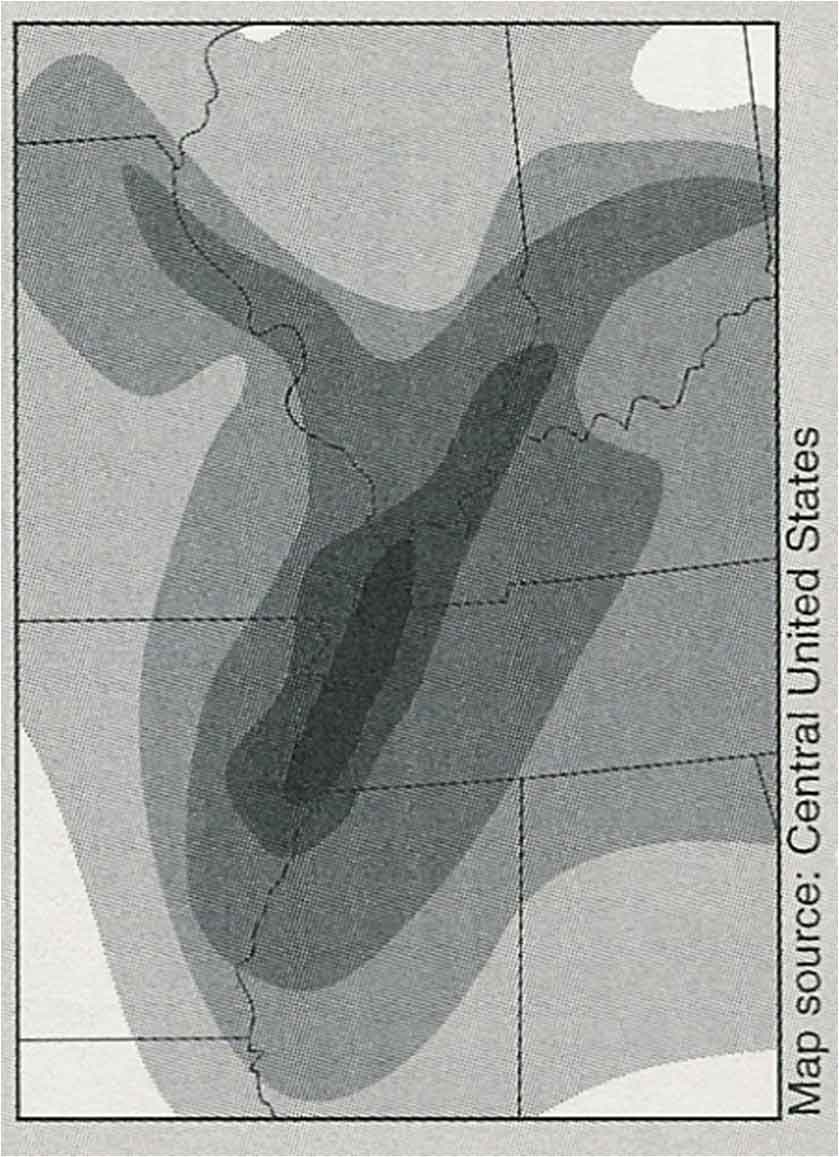
The New Madrid Fault
is a major active fault line that runs
approximately from Memphis, Tennessee, to
St. Louis, Missouri. On Dec. 16, 1811, this area was hit
with an estimated 8.6 magnitude quake on the modern-day
Richter scale. This was the first of THREE major quakes to
rock the Midwest. A second quake on January 23, 1812 is
estimated to have been an 8.4. A THIRD shock on February
7, 1812, is estimated to have been the strongest jolt ever
to hit the North American continent at somewhere near 8.7
to 8.9.
We pulled some illuminating facts
from Volume
3 of DISCOVER! America’s Great River Road… What
would an 8.7 magnitude earthquake feel like?
The New Madrid earthquake
released energy equal to 150,000,000 tons of TNT. In
comparison, the two atomic bombs dropped on Hiroshima and
Nagasaki in WWII equaled 35,000 to 40,000 tons of TNT!!
When the tremors and convulsions of the earth
subsided, 30 to 50 thousand square miles of land had
undergone vast topographical changes. Most of which are
visible today. In the northwest corner of Tennessee, land
dropped 10 to 20 feet and caused the Mississippi River to
flow back upon itself which formed REELFOOT LAKE. In places
along the Mississippi River, I have seen sandboils which
still lie barren, or waves of undulating earth frozen into
the compacted soil.
The New Madrid fault system extends
120 miles southward from Cairo, Illinois, through
New Madrid and Caruthersville, Missouri,
following I-55 free way system to Bytheville and on
down to Marked Tree, Arkansas. Buried five to to ten
miles underground (similar in depth to the Haiti quake), it
crosses five state lines and cuts across the Mississippi
River in three places.
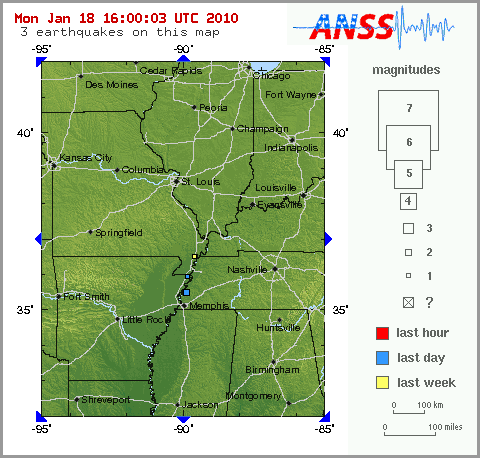
THE USGS maintains a real time list of tremors along the
New Madrid fault. Click map image to see the map for
today.
Return to our general
INDEX of
FEATURE STORIES
Return to the MISSISSIPPI RIVER HOME PAGE at
www.greatriver.com
Stories from SURVIVORS of the
New Madrid Earthquake of
1811-1812
related in part from "Reelfoot Lake and the New Madrid Fault"
by Juanita Clifton, 1980
Witnesses report that about 2 a.m. on December 16, 18aa, the
earth around the little settlement of New Madrid, Missouri,
began to rise and fall like waves upon the sea. When the peaks
of the waves rolled through the Mississippi River, the river
bottom heaved up, emptying the river onto its banks, inundating
the shores and leaving some boats on dry land. When the troughs
followed, the river rushed back into the hollows with such force
that entire groves of trees were drawn out by the roots and
thrown into the river.
On dry land, trees bent like heads of grain in the wind,
their ranches interlocked, until they were ripped from the
ground. Cracks formed in the earth that sometimes ran for MILES.
The quake's ground wave created sunken lands, fissures, and
domes. Sand blows eruped sand and belched hot water, fumes, and
carbonized wood.
Mattis M. Speed, a river traveler in February, 1812,
described his experience. "We were awakened about 3 a.m. by the
violent agitation of the boat accompanied by a noise so terrible
it can best be described as the constant discharge of heavy
cannon. The banks were falling into the river and the island to
which we were tied was sinking. We cut ourselves loose from the
island and pulled as far from the banks as necessary to avoid
the falling trees. The swells of the river were so deep as to
threaten the sinking of the boat with every minute."
When he pulled out of the maelstrom at New Madrid, he wrote,
"The former elevation of the bank was about 25 feet above common
water. When we reached it, it was barely 12 or 3 feet. Scarcely
a house was left entire, some completely prostrated, others
unroofed and not a chimney standing."
One man described holding to a tree to support himself during
a quake. A fissure opened in the ground and both he and the tree
fell in. He was unable to climb out of the fissure at that point
and was forced to walk along it until an incline allowed him to
scramble out. Fissures as deep as 100 feet ran for miles through
the countryside.
New Madrid Earthquake Creates Reelfoot Lake
Both Reelfoot Lake, Tennessee, and St. Francis Lake in
Arkansas were formed by the New Madrid Earthquake in 1811, 1812.
A citizen from New Madrid, Missouri, wrote in 1816, "Lately, it
has been discovered that a Lake was formed on the opposite side
of the Mississippi River, in the Indian country, upwards of 100
miles and from one to six miles wide, of a depth of from 10 to
50 feet."
The epicenter of the quake was about 70 miles southwest of
modern Reelfoot Lake and more than 1800 recorded tremors, some
of which rang bells on the east coast, followed by the first
powerful jolts.
In 1815, Congress passed an act to relieve area inhabitants
who found their riverside farms swallowed up or buried in the sand
that spewed from the earth. More than 500 earthquake
"certificates", redeemable for up to 640 acres of government
land, were allotted. The site of Hannibal, Missouri, was one of
the resultant land grants.
The TIPTONVILLE DOME
A dome-like rise in the otherwise perfectly flat land is
clearly visible on the west side of Reelfoot Lake, on the road
from the Airpark Inn to Tiptonville, Tennessee. The Tiptonville
Dome formed when the land around Reelfoot Lake sank during the
earthquake. Above the newly formed depression, the Mississippi
River appeared to flow backward when the waters rushed to fill
the depression--the center of which is now Reelfoot Lake.
The raising of the dome also created a natural dam that, for
a short time, forced the Mississippi River to flow back south
upon itself. The same dam trapped water in low swampland in the
vicinity of Reelfoot Creek and Bayou de Chien, eventually
allowing Reelfoot Lake to form.
Return to our general
INDEX of FEATURE
STORIES
Return to the MISSISSIPPI RIVER HOME PAGE at
www.greatriver.com
 With
all the media coverage of the 7.0 magnitude
quake in Haiti
With
all the media coverage of the 7.0 magnitude
quake in Haiti