TUNDRA SWANS Return to the
Mississippi River
with Mississippi River author, Pat Middleton,
Michelle Marron and Ruth Nissen, Wisconsin DNR
MISSISSIPPI RIVER HOME |
WATERWAY CRUISE REPORTS
| River Books, Note Cards
and Gifts |
Feature Articles |
FISHING|
| Hand-painted HISTORIC
MAPS | River
Classifieds | Contact Us |
Press Releases |
Photo Gallery |
Links |
BIRDING |
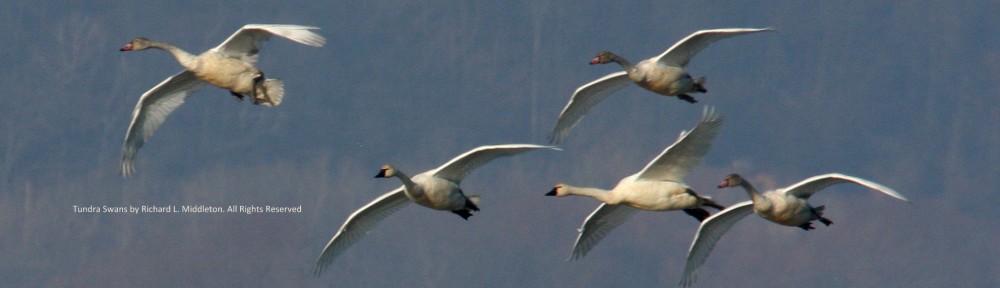
Tundra swans rest on Pools 4-11 during the fall migration, moving through just before ice forms on the river. More arrive daily, building up to their peak population during the month of November. By all means swing over to the overlooks along Hwy 26 just south of Brownsville, Minnesota, or south of Goose Island on the Wisconsin shore.
The Army Corps of Engineers has finished several new islands just off the wayside overlooks just south of Brownsville, which makes for superb birding. At our recent visit, they were peppered with migrating ducks and at least 50 adult Bald Eagles. Once the Tundra Swan family groups begin arriving, Tundra Swans are abundant just below Goose Island between La Crosse and Stoddard, Wisconsin.
Harry Buck of Alma organized the first swan watch at Rieck's Park north of Alma, Wisconsin, after he heard a visitor videotaping 4,000 tundra swans saying that "all the noise was coming from these egrets."
(From DISCOVER! AMERICA'S GREAT RIVER ROAD, Volume 1, by Pat Middleton )
Common American Swan
(Tundra Swan)
Audubon painted this swan in London in 1838. He wanted the yellow water lilies to be named Nymphea leitnernia after Edward F. Leitner, a German botanist killed by Seminoles in 1838.
"Dr. Leitner also procured some [flamingos] in the course of his botanical excursions along the western coast of the Floridas, where he was at last murdered by some party of Seminole Indians, at the time of our last disastrous war with those children of the desert." -- John James Audubon
Table of Contents
Custom Search
These birds of the arctic tundra are migrating to their wintering grounds on Chesapeake Bay and the estuaries of the east coast. Another population of tundra swans migrate to California's San Joaquin and Sacramento Valleys to spend the winter. Migrating during the day and night, their trumpeting calls are heard at a great distance as they fly along in their familiar V-formation. During flight, the swans can achieve speeds up to 100 miles per hour with a tail wind. They have been sighted at elevations of 6000 to 8000 feet where flocks have been struck by aircraft!
Pools 4-11 of the Mississippi River provide the swans with a place to rest and feed on their way to wintering grounds. While here, the tundra swans feed mainly on starchy bulbs or tubers of plants such as arrowhead (duck potato), wild celery, and sago pondweed. The tubers are buried in the mud on the bottom of the river, but the swans are well equipped with powerful legs, large webs, and prominent toes to stir up the soft mud and dislodge the tubers. With their long necks, they can usually reach the bottom by just immersing their head and neck, but sometimes in deeper water they tip up so that only the tail protrudes above the water. Ducks often feed close to swans taking advantage of the small animal and plant material distributed by the swans.
Where to View Swans
Some of the best places to view tundra swans during migration are located on the Mississippi River between Pools 4 and 8. One of the best places to view the birds up close, is the platform at Rieck's Lake Park just north of Alma, Wisconsin on highway 35. Swan Watch volunteers will be at the platform most weekdays and all weekends from 9 a.m. to dusk through November 23.
Other traditional viewing sites include Weaver Bottoms in Minnesota, and along highway 26 in Minnesota where swans gather in the northern part of the Wisconsin Island Closed Area in Pool 8.
When Will the Swans Return in the Spring?
On the return flight in spring, the swan's progress is slower, and they stop more frequently than on the fall trip. Thus they seldom appear in large enough groups to be noticeable. But they will follow the ice thaw to the north. Open water, which may appear in March, indicates taking a closer look at any large, long-necked waterfowl. Pelicans reappear at about the same time... but are distinguished by shorter necks and longer bills.
They nest in the tundra or sheltered marshes on the Alaskan and Canadian coast near the Arctic Circle. Swans mate for life, although if one dies, they will find a new mate. After choosing a nesting site, the swans gather and pile up grass, sedges, and mosses to make a nest measuring about 6 feet across and twelve to eighteen inches high. The female lays 2-8 eggs and incubates about a month. Cygnets hatch in late June and stay in the family for about one year.
The young of the year can be distinguished by the grayish white color, the darker heads, and the pinkish, bills; by their second trip to this area they will have their adult plumage.
MISSISSIPPI RIVER HOME | WATERWAY CRUISE REPORTS | River Books, Note Cards and Gifts | Feature Articles | FISHING| | Hand-painted HISTORIC MAPS | River Classifieds | Contact Us | Press Releases | Photo Gallery | Links | BIRDING |
 Custom Search
We are rated #1 by
for Mississippi River Travel, Great River Road, and many many other related
Mississippi River topics!!!!!
Advertising on www.greatriver.com puts your business in front of over 35,000 UNIQUE ADDRESSES each month.
More than 2,600 different sites link to greatriver.com© 2000 Website Design by
Great River Publishing
Rt. 1, Stoddard, WI 54658-9801
Phone 608-457-2734 or email us by clicking on the envelope and requesting complete information.
Photos and Content may not be used in any format without the express permission of Great River Publishing.
